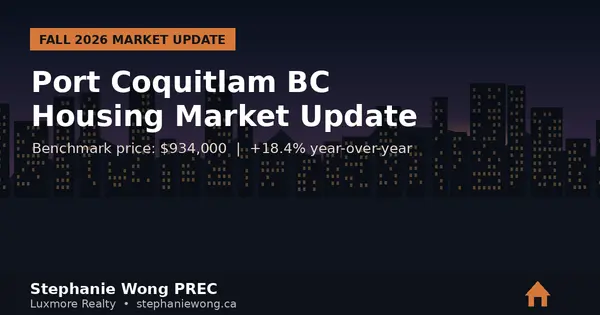
Why Investors Are Looking at Port Coquitlam, BC in 2026
Investors are turning to Port Coquitlam in 2026 because it offers something increasingly rare in Metro Vancouver: relative affordability paired with SkyTrain access, steady rental demand, and real infrastructure investment. I'm Stephanie Wong, and as a Realtor with Luxmore Realty working across the Tri-Cities, I've watched Port Coquitlam shift from an overlooked commuter suburb into a market buyers are actively comparing to Coquitlam and Port Moody before they write an offer.
This isn't a "guaranteed returns" story — no market is. But the fundamentals worth watching are clear, and I'll walk through what's actually driving interest in PoCo right now.
Key Takeaways
- Fraser Valley's composite benchmark home price sat at $877,600 in July 2026, with single-family detached homes down 8.3% year-over-year — a window of relative affordability for buyers (Fraser Valley Real Estate Board, July 2026).
- Metro Vancouver's rental vacancy rate climbed to 3.7% in 2025, still tight by historical standards, while Coquitlam-area rental stock saw its biggest increase in 20 years (CMHC 2025 Rental Market Report).
- Port Coquitlam's population was recorded at 61,498 in the 2021 census, with the city reporting continued growth since (Statistics Canada).
- The City of Port Coquitlam has multiple capital projects underway through 2026-2027, including Kingsway Avenue upgrades and a new affordable rental funding program (City of Port Coquitlam).
The Affordability Gap Between Port Coquitlam and Its Neighbours
Buyers priced out of Coquitlam and Port Moody are increasingly looking one exit down the Mary Hill Bypass. Fraser Valley Real Estate Board data from July 2026 put the region's single-family detached benchmark at $1,335,200, down 8.3% from a year earlier, while townhomes sat at $757,300 and apartments at $469,500 — all lower than the same period last year (FVREB, July 2026). Nearby Coquitlam's composite benchmark was $1,003,300 as of the most recent board reporting.
I tell clients considering Port Coquitlam the same thing I'd want to hear: this pricing gap is real, but it moves month to month, so lean on current board data rather than a number you saw six months ago. What doesn't change as quickly is the location — Port Coquitlam still sits inside the same Millennium Line SkyTrain catchment as Coquitlam Centre, so the commute advantage that anchors Tri-Cities demand applies here too.
Rental Demand Still Favours Landlords in the Tri-Cities
Metro Vancouver's rental vacancy rate rose to 3.7% in 2025 — the highest in three decades — up from 1.6% the year before, according to CMHC's 2025 Rental Market Report. That's a meaningful loosening, but a 3.7% vacancy rate is still considered a landlord's market by most standards, and it followed the largest increase in purpose-built rental stock the Coquitlam area has seen in 20 years, meaning new supply is being absorbed rather than sitting empty.
For investors, that combination — more inventory but demand keeping pace — is worth watching closely rather than reacting to a single headline number. Average two-bedroom rents across Metro Vancouver reached $2,363 in the CMHC report, giving investors a regional benchmark, though actual achievable rent in Port Coquitlam depends heavily on unit type, building age, and proximity to the West Coast Express and Millennium Line.
Infrastructure Spending Is a Signal, Not a Guarantee
I always tell investors to watch where a city is putting its capital budget, because it tells you where growth is expected to hold. Port Coquitlam has Phase 3 of its Kingsway Avenue upgrade project — including new turning lanes at key intersections — moving forward in 2026, alongside a Cedar Drainage Pump Station project running from January through June 2026 in the city's north end (City of Port Coquitlam Capital Projects).
The city is also preparing to launch a Pre-Development Funding Grant Program in 2026, aimed at helping non-profit housing providers move affordable rental projects toward construction (City of Port Coquitlam). None of this guarantees appreciation — no infrastructure project does — but sustained municipal investment in transportation and utilities is generally a sign a city expects, and is planning for, continued growth.
Who Port Coquitlam Actually Works For
Port Coquitlam's housing stock is a genuine mix — established single-family homes in areas like Oxford Heights and Riverwood, newer townhome complexes, and low-rise condo buildings closer to the West Coast Express station. That variety matters for investors because it creates more than one entry point: a townhome purchase looks very different from a detached rental property, both in upfront cost and in the tenant pool it attracts.
In my experience helping buyers across the Tri-Cities, the investors who do well here are the ones who match the property type to a specific tenant profile — commuters who want SkyTrain or West Coast Express access, or renters trading Coquitlam's price tag for a shorter drive to the same amenities. I never advise clients to buy based on a projected return; I walk them through current comparables, financing costs, and realistic rent expectations so they can make their own informed call.
Frequently Asked Questions About Investing in Port Coquitlam, BC
Is Port Coquitlam cheaper than Coquitlam for real estate investment? Generally, yes. Fraser Valley Real Estate Board data shows Coquitlam's composite benchmark price running higher than Fraser Valley's broader benchmark of $877,600 as of July 2026, and Port Coquitlam typically prices below Coquitlam and Port Moody for comparable housing stock.
What is the rental vacancy rate near Port Coquitlam? Metro Vancouver's overall vacancy rate was 3.7% in CMHC's 2025 Rental Market Report, up from 1.6% the prior year, though Port Coquitlam specifically was not broken out separately in that report.
Does Port Coquitlam have SkyTrain access? Port Coquitlam is served by the West Coast Express and sits adjacent to the Millennium Line's Coquitlam Centre station, making it accessible to the same rapid transit network as Coquitlam and Port Moody.
What kind of housing stock does Port Coquitlam have for investors? The city has a mix of established single-family homes, townhome complexes, and condo buildings, giving investors multiple entry points depending on budget and target tenant.
Is now a good time to invest in Port Coquitlam real estate? That depends on your financing, timeline, and risk tolerance — I don't guarantee returns for any client. What I can do is walk you through current FVREB data, comparable sales, and realistic rental income for a specific property so you can decide with real numbers in front of you.
Ready to Explore Port Coquitlam as an Investor?
Port Coquitlam's combination of relative affordability, transit access, and active infrastructure spending is worth a serious look if you're building or expanding a rental portfolio in the Tri-Cities. The pricing gap with Coquitlam and Port Moody won't necessarily last, and the specifics — which property type, which neighbourhood, which financing structure — matter more than any headline statistic.
I'd be glad to walk you through current listings and comparables in Port Coquitlam so you can see exactly what today's numbers look like for a property that fits your goals. Call me, Stephanie Wong, at (778) 960-8269, or schedule a free consultation at stephaniewong.ca/contact to get started.
Categories
Recent Posts